Thursday, May 15, 2008

How and Why to Report Graffiti

An important aspect of the new Enhanced Graffiti Management program that the City of Ottawa has rolled out is the by-law enforcement of graffiti removal.

Over the last 3 years graffiti has been slowly accumulating on properties as tags and response tags have been stacking up. Some property owners have chosen to be diligent about removing graffiti from their properties promptly…while others have chosen to ignore it and let graffiti remain on their properties (in some cases for years). And year by year this slow accumulation of graffiti on properties that have not been maintained has allowed graffiti in Ottawa to reach a tipping point.

This, in conjunction with aggressive “bombers” who have been heavily tagging highly visible street-facing locations, has created a “bubble bursting” effect. Graffiti that once had been invisibly to everyone has abruptly come into the consciousness of many, as if almost having sprung up everywhere overnight.

By allowing graffiti to slowly accumulate to a critical mass point graffiti writers have run out of innocuous places to place graffiti and the hype and visibility of graffiti has increased and increased to the point that aggressive bombing now seems acceptable and common.

In order to bring graffiti back under control in Ottawa it is essential for concerned citizen to report graffiti to the City of Ottawa.

So How Do You Do That?

First step is to go out and identify what properties are graffitied and how. To do so, take down the street address of the property, and the location of graffiti on the property. Also take note of the type of graffiti (e.g., small tags, large tags, throws, pieces). And as you are checking out the property, take the time to look a little deeper. Is their graffiti on rooftop surfaces? Is there a back alley to the property? Try to take account of the full complexity of graffiti on the property so that you can pass this detailed information on to City By-Law officers and reduce the need for follow-up reports on the same property.

Next you’ll need to submit your graffiti report by calling the City of Ottawa’s Contact Centre at 311.

Once you’ve reached a 311 agent, identify that you are calling to make a graffiti report and that you will want to take the reference number of the report.

As the agent opens up the report they’ll ask you for the following information.

- Your name
- Your phone number

Note: This information will not be disclosed or provided to anyone. It is contact information that is required for each report in case the City of Ottawa needs to collect additional information on the graffiti you are reporting.

- What type of property the graffiti is it on (City property or Private property).
- Is the graffiti just vandalism, or hateful/racists/sexist?
- The street address of the property
- The location and type of graffiti on the property (i.e., location on the building, description of the graffiti).

In order to follow-up on the status of your graffiti report make sure to ask for the Reference Number for each report that you submit. If you are making multiple reports (for instance, of a few properties along a street), make sure to make individual reports for each property and take the Reference Number for each. If an agent is gathering multiple addresses into a single report, ask them to create individual reports for each address (the City actually requires that by-law reports be for a single property, so if the Call Centre agent is collecting multiple addresses in one report they are doing so mistakenly and will have to break them out into individual reports anyways).

And that’s it.

What Happens Next?

The City will send out a By-Law Enforcement agent to inspect the property based on your report…and if there is graffiti on the property a warning will be provided to the property owner. If the property owner chooses not to remove the graffiti, after a reasonable timeframe the City will send out a contracted graffiti removal agent to clean the property, and will charge the costs of removal to the property by adding it to the property tax of the building.

So if after a month you notice that the property you made a report on hasn’t improved at all, you can call back into the City Call Centre at 311 and using the Reference Number (or your name and address) ask for a status on the graffiti report you made.

Is This Really Necessary? It Sounds a Bit Mean Spirited!

Unfortunately taking control of the graffiti situation in Ottawa is necessary. Through apathy graffiti has flourished and proliferated throughout Ottawa. Property owners have turned a blind eye to graffiti on their properties…and chosen to ignore it; by doing so graffiti has been allowed to spread to adjacent properties and throughout whole neighbourhoods.

The only way to wake property owners from their slumber and to get them involved is to force them to take accountability for the graffiti on their property….and the cost of its removal. In doing so property owners will become fed up and angry, and will find ways to secure their properties (e.g., by limiting access to rooftops, by being vigilant of their property, by taking a more proactive role in patrolling their neighbourhoods and communities to make graffiti writers unwelcome)

Untold Victim: The Destruction of Art

Unfortunately graffiti isn’t always just vandalism. Some graffiti writers and street artists are incredible creative and skilled. They add colour and beauty to what can often be a drab and sterile cityscape. But due to the wanton vandalism of a handful of attention-seeking delinquents and copy cats, graffiti has been tainted in Ottawa. And vandalism has made it hard to see the art that peppers our city from the noise. Where once secluded “chill” spots were allowed to exist and add creative colour to our city…now untalented “bombers” have invaded those spots and spoiled these quiet oases for everyone. And sadly, street artists and creative graffiti writers will pay the price for the attention-seeking bomber that have stomped their chill spots. And most sadly of all, in the process many historical works of graffiti art and street art will end up buffed in the process.

So some advice to the Ottawa graffiti crowd (both legit and illegit), police your own community before you end up having your community policed by someone else.

Tuesday, May 6, 2008

Graffiti Removal Kits

As part of the Enhanced Graffiti Management Program the City of Ottawa is currently providing Graffiti Removal Kits to citizens interested in removing graffiti from public property. These kits are only good for non-porous flat surfaces (glass, metal, non-porous plastics).


The kit is a plastic container containing 30 graffiti wipes, vinyl gloves, and City of Ottawa instructions.

Kits can be acquired by contacting and picking them up from Paul McCann (613-580-2424 ext. 13363), the Co-ordinator of the Community Pride Program.

So now you have a kit. What do you do next?

First off read the instructions...and read the label. The graffiti wipes are coated with very strong chemical and solvents, so be informed so you can be careful.


Next, find location to remove graffiti from. As these graffiti removal kits are provided free of charge from the City they are intended for City of Ottawa property and street furniture (street signs, newspaper boxes, taffic switching boxes, bus shelters, telephone booths, mail boxes, mail drop boxes, telephone switching boxes). The City does not recommend or advice you to clean Hydro boxes as they may poentially pose an electical shock danger.


If you are paying attention at home...this is a Hydro box. We advise that you don't clean this type of street furniture. We weren't paying close attention and cleaning this one.

Next you'll need your tool.


  • Graffiti wipes
  • Razor scrapper
  • Face mask
  • Vinyl gloves
First off, use the razor scrapper to remove any stickers.


Once your cleaned your surface of stickers...it's time to put on your protective gloves and mask.


Next, start with a clean graffiti wipe and start wiping away at that graffiti.


Depending on the type of ink or paint used...some marks will come off immediately. Other may need to soak a bit in the wipe solvent. And others still will need some serious elbow grease.


And some will just not want to completely come off.

The wipes pick up paint and ink fast. But there may be a lot more ink and paint on the surface than you think, so you'll likely need a few wipes to cover a heavily graffitied surface. Also, as you work away your gloves are not going to hold up very well.

So replace your gloves whenever they wear out.


For stubborn tags, like solid paint markers (which leave a thick residue), we suggest that you use a razor scrapper to remove as much excess paint/ink as possible...and then go over the surface with a graffiti wipe. You'll be surprised how much time this will save you and how effective it will be.

So what's the verdict?

Well for simple tags...very good. You can remove all traces of graffiti


But for more complex graffiti and graffiti that has had a long time to set...you may not be able to erase all traces of graffiti...but just make a really big dent.

BEFORE


AFTER


Thursday, April 24, 2008

How Graffiti is Made

Graffiti writers put up graffiti using a variety of methods, including the following.
  • Markers
  • Spray Paint
  • Stickers
  • Scratching (or Scratchiti)

Markers

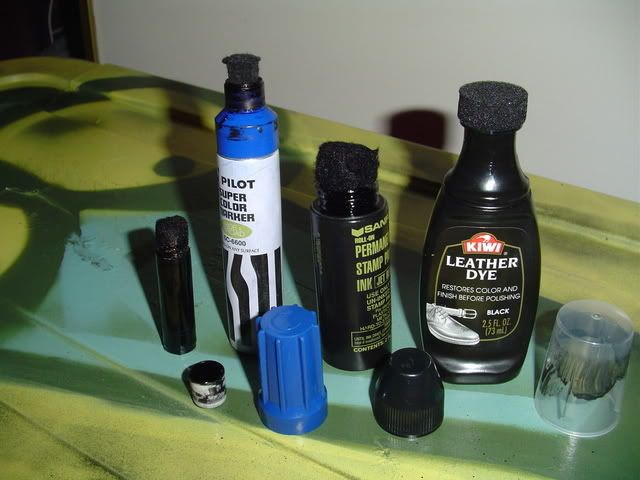
Markers can be ink-based or paint-based; and paint-based marker can also be liquid paint or solid paint (which leave a thicker residue and are effective on rough surfaces).

Markers are used to leave quick tags.

Solid paint markers can be used on both flat and rough surfaces. Liquid ink and paint markers are typically used on flat surfaces. Liquid markers can be felt-tipped or mop-tipped. A felt-tipped marker is like a typical Sharpie or Pilot...but of a larger format. Mop-tipped markers have a sponge tip or “mop” (like on a shoe polish bottle or bingo daubber) and can come in squeezable containers to create stylized drips. Markers can be regular art supplies or specialized graffiti-specific markers (which are sold by custom graffiti suppliers [e.g., Molotow, Krink, Junobo, On the Run] or custom fashioned by graffiti writers from shoe polish bottles/bingo daubers and ink/paint). To make graffiti-specific marks more destructive and indelible the ink and paint used in them is typically supplemented with brake fluid to leave permanent stains on surfaces.

Spray Paint

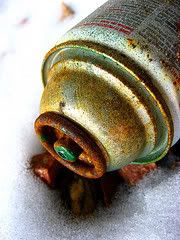
Spray paint is used for creating large complex graffiti pieces...but they can also be used to throw-up quick tags. For this reason spray paint is a highly-prized graffiti medium, as it is versatile and also used for prestige work (like bombing or aggressively tagging all businesses on a street, or for putting up complex time-consuming pieces). Graffiti writers typically use spray paint on porous surfaces (for which most markers wouldn't be ideal) like stucco, brick, cement, and stone. Spray paints are often weather-proof or rust-resistant (for metal surfaces, like Rust-oleum or Rusto, and Tremclad) or have custom-designed colours created by graffiti-specialty suppliers (e.g., Krylon, Montana, Molotow).

Stickers

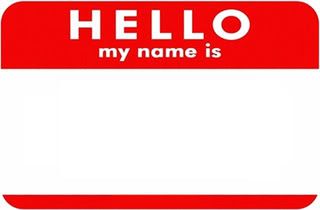
Graffiti can also be created with stickers. Because stickers can be created at home, street artists will also use stickers as a medium to create intricate artwork to place out on public surfaces. The line between street art and graffiti is fine, and open to personal perspective...some people find street art to be rich and vibrant, adding colour and style to the hum-drum surfaces of our modern city. Stickers can either plastic or paper-based. Plastic-stickers are typical made and orderd from a custom supplier and are weather resistant. Paper-based stickers are cheaper and can be purchased at dollar stores (e.g., name-tag stickers) or procured for free using postal service label stickers that are provide free of charge to the public. Custom-sized stickers can then be created by layering sticker upon sticker. Once ready, stickers can then be applied to any flat surface (metal, plastic, glass). Often stickers will be affixed to public street furniture (the backs of street signs, postal equipment [relay points, street letter boxes, drop boxes], telephone equipment [telephone booths, telephon switch boxes], hydro transmission boxes, newspaper boxes, bus shelters, lighting poles). As paper-based sticker fade and degrade from the sun and rain, they are often placed indoors (e.g., in bathrooms) or in sheltered areas (e.g., on the inside window of a newspaper box) where the elements won't impact them as much.

Scratching (Scratchiti) and Etching

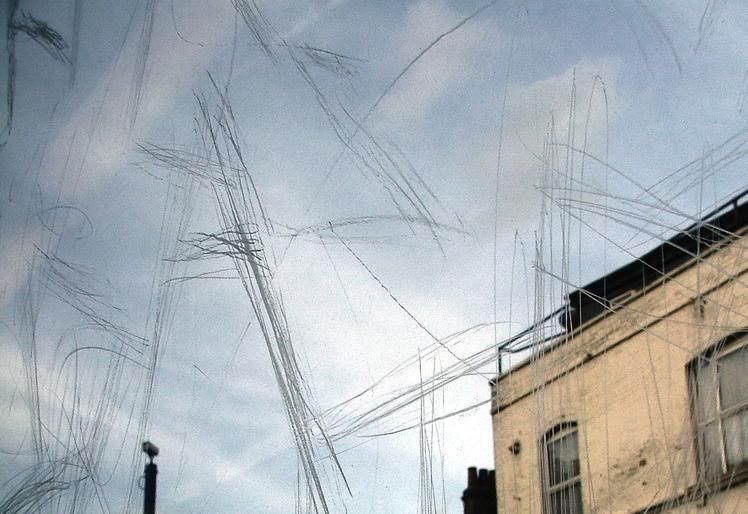
Graffiti can be made on glass, plastic and metal surfaces (as ink and paint can be easily removed from these surfaces) by scratching into these surfaces with a glass-cutter or a sharp blade. Additionally sometimes acid etching is used to graffiti glass, plastic and metal through the application of hazardous toxic solvents.

Tuesday, April 22, 2008

Graffiti Terms

Like all specialized environments, graffiti has a language of its own. Here’s a brief overview of some graffiti terms.

Basic Terms
  • scratchiti - Graffiti that has been created by scratching onto a surface (glass, plastic, metal)
  • stickie - A sticker with the writer's tag on it. A sticker can be deployed more quickly than other forms of graffiti, making it a favorite in especially public places like newspaper dispensers.
  • tag - A stylized signature, normally done in one color. The simplest and most prevalent type of graffiti, a tag is often done in a color that contrasts sharply with its background. It is the writer's logo, his/her stylized personal signature. If a tag is long it is sometimes abbreviated to the first two letters or the first and last letter of the tag; and may be ended with the suffixes "one", "ski", "rock", "em" and "er".
  • throw-up or throwie - A throw-up or throwie sits between a tag and a piece in terms of complexity and time investment. It generally consists of a one-color outline and one layer of fill-color. A throw-up is designed for quick execution, to avoid attracting attention to the writer. Most artists have both a tag and a throw-up which act as recognizable logo for others to identify them and their style.
  • piece - A graffiti painting, short for masterpiece. It's generally agreed that a painting must have at least three colors to be considered a piece.
  • roller - A large graffiti piece that has been created using a paint roller instead of spray paint
Other Graffiti Terms
  • bite - To copy another writer's style
  • black book or piecebook - A graffiti artist's sketchbook. Often used to sketch out and plan potential graffiti, and to collect tags from other writers.
  • bomb - To bomb is to aggressively graffiti a whole area (for instance the length of a street) by painting many surfaces. Bombers often choose throw-ups or tags over complex pieces when bombing, as they can be executed more quickly.
  • buff - To remove painted graffiti with chemicals and other instruments, or to paint over it with a flat color
  • burner - A well produced graffiti piece that is complex and exceptional
  • drips - Stylized drips on letters for added effect
  • fill - The solid interior color of letters on a piece or throw-up
  • going over - To go over or paint on top of a piece of graffiti simply. While most writers respect one another's artwork, to intentionally and disrespectfully paint on top of another's work is akin to a graffiti declaration of war. However (due partially to the limited amount of desirable wall-space) most graffiti writers maintain a hierarchy of sorts; a tag can legitimately be covered by a throw-up, and a throw-up by a piece, and this is commonly done without incident.
  • handstyle - The handwritten style in which a graffiti writer draws their tag. Often handstyle tags are done in a single fluid line.
  • hit - To tag a surface with paint or ink
  • outline - An uncoloured piece/blueprint of a full colour piece
  • run - The length of time graffiti remains up before being covered or removed
  • toy - An inexperienced or unskilled writer. Graffiti writers usually use this as a derogatory term for new writers in the scene. A writer considered a "toy" is especially targeted for slashing or going over.
  • up - Describes a writer whose work appears regularly everywhere and who is currently writing (for instance, “getting up”, “being up”…as in being up on a wall)
  • wildstyle - A complicated construction of interlocking letters. A hard style that consists of lots of arrows and connections. Wildstyle is considered one of the hardest styles to master and pieces done in wildstyle are often completely undecipherable to non-writers.
  • writer - Another word for a Graffiti artist

Friday, April 18, 2008

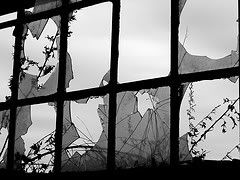
The "Broken Window" Theory

When it comes to graffiti, aside from the cost to clean and repair (which can be expensive), graffiti’s most insidious and pervasive cost is to a community’s sense of security.

The effect of graffiti on a community is often likened to the metaphor of a “broken window”. This theory was first proposed by James Q. Wilson and George L. Kelling in a March 1982 article called “Broken Windows” in The Atlantic Monthly, and can be synopsized through the following excerpt.

"Consider a building with a few broken windows. If the windows are not repaired, the tendency is for vandals to break a few more windows. Eventually, they may even break into the building, and if it's unoccupied, perhaps become squatters or light fires inside.

Or consider a sidewalk. Some litter accumulates. Soon, more litter accumulates. Eventually, people even start leaving bags of trash from take-out restaurants there or breaking into cars."

Viewed through this frame, graffiti similarily acts as an indicator of communal neglect and lack of care. One graffiti tag becomes an open call for other graffiti writers to add in their voice…in support or in challenge. Before long, if left unchecked, the tagged surface becomes a message board which all taggers feel free and obliged to use to make their voices and presence heard.

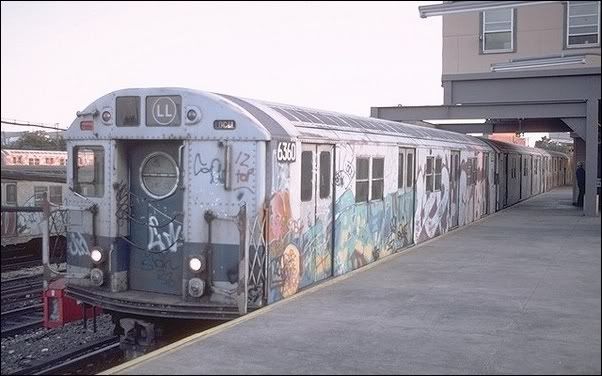
The “Broken Widow” theory was eventually put to the test by the City of New York in the 1980. New York had been facing a steady and dramatic increase and escalation in criminal activities.

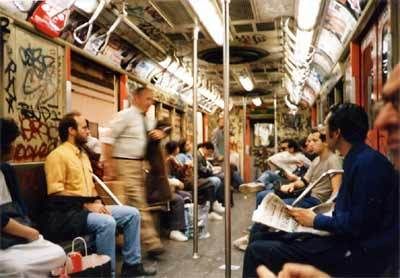
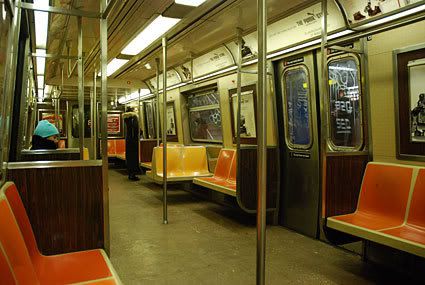
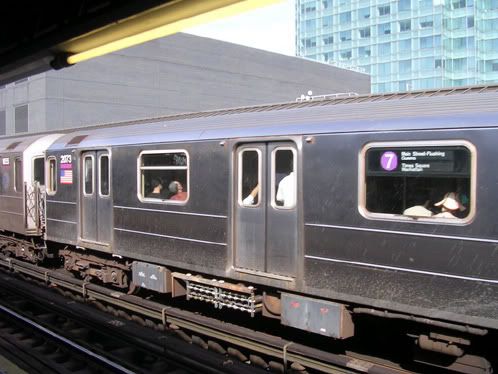
The NYC Subway was totally overrun with graffiti and toll dodging was a common occurrence. As a test of the Broken Window theory in 1985 the New York City Transit Authority implemented a zero tolerance program towards graffiti and toll-jumping. This included ensuring that all graffitied subway cars were checked and cleaned after each run and not put back into service until they were free of all graffiti.


Though the effect of these actions are often questioned and difficult to definitively inter-relate, the change in atmosphere and perception of security in New York City between the early 1980s and the present day is dramatic and radical. The NYC Subway Broken Window test bed led to further sweeping changes by Mayor Rudy Giuliani during the 1990s which resulted in the revitalization of the commercial downtown core of NYC and the gentrification of New York City’s boroughs.


Thursday, April 17, 2008

Gladstone Avenue

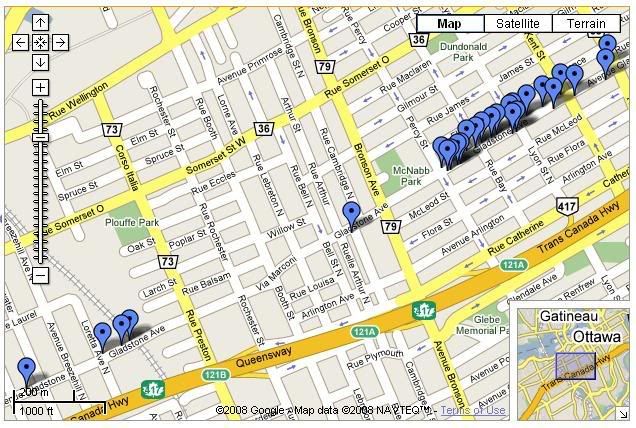
Gladstone avenue is another area in Ottawa that has been heavily hit with graffiti.


The graffiti along Gladstone is typically concentrated in a few key areas/corners where properties owners have neglected to keep on top of graffiti...and a dialog between different taggers has emerged. Along Gladstone corner stores, vacant lots, parking lots, and key corners are prime examples of where and how graffiti takes hold in a community.

Graffiti can be seen to drop off westard as residential properties and homes increase. This is due to the fact that commercial properties are the prime target for graffiti writers, as they present hubs for the community and have high traffic (and thus greater visibility)...and are also anti-establishment targets due advertising and commercialism.

Tuesday, April 15, 2008

Removing Graffiti

There are a lot of resources out on the Internet on how to remove graffiti. But to synopsize them, here are the basics.

Graffiti removal depends on surface type. And there are three general types of surface.

- Wood
- Flat Surfaces (Glass, Metal, Plastics)
- Porous Surfaces (Brick, Cement, Concrete, Stucco)

Removal falls into the following basic approaches.

- Repainting
- Chemical solvents
- Pressure washing, sand blasting, sanding

Wood

With wood the best and easiest bet is to paint the surface.

Experts suggest that you should try to stay away from light colours (like white)...as a white wall is pretty much just a fresh canvas. However, going to dark colours (like black and greys) can also present a fresh canvas...just to white markers and paint. The pros and cons vary. With a standard colour like white or black you can always easily repaint. But choosing a colour that doesn't draw too much attention (like a wood simulating brown, or a colour that blend in with the surrounds) is likely a good idea.

If you want to preserve the natural look of wood....you can sand, pressure wash or sand blast the surface to remove graffiti and get down to the bare wood. It's just important to be careful and tentative...as power washers and sand blasters can chew up wood pretty fast. Get a powerful power washer...and put it on a gentle setting...then do some test areas to get a feel for what works.

Solvents can work on wood if you use them early. Most thinners will remove magic markers and acetone will remove spray paint if a day old.

Flat Surfaces

With glass and metal surfaces you can use standard solvents to remove graffiti.

The City of Ottawa currently will provide, free of charge, graffiti removal kits to use on flat surfaces (Tel.: 613-580-2424 ext. 13363). These kits are intended to be used on public surfaces (Telephone booths, Hydro boxes, Bell boxes, Light posts, Mail boxes, Garbage receptacles)...but obviously can also work on private surfaces. If you are going to take advantage of these City resources you'll need to request them and pick them up (at City Hall or at the storage depot by Industrial Avenue). They are intended to clean-up graffitied public street surfaces (so keep that in mind when you request them). If you plan on using them on private surface you should definitely also make a dent in the public graffiti in your area (to keep the area clean and graffiti at bay...your graffiti-clean property won't stay that way long if the rest of your street is heavily graffitied).

Glass and Plexiglass can also be cleaned with a razor blade to scrape away paint. But be careful with the solvent you use, acetone-based solvent will affect plastics. Test spots and carefully reading directions is highly recommended on your first go.

Acetone-based solvents will soften plastics. So best options are to use full-strength paint remover and rinse.

Additionally, metal and plastic surfaces can also be repainted with a colour-matched paint. But choose a paint type that will cover well and adhere to the surface. Scuffing the surface with a little sand paper will ensure that the paint covers better...using a paint that does not adhere well will lead to peeling, flaking and chipping once the surface has had the chance to shink and expand across the year.

Porous Surfaces

Brick, Cement and Concrete can be soaked with solvent and scrubbed gently with a wire brush. After some time to set in...a strong stream of water can be used to rinse the surface. If this doesn't work, a pressure washer or soda-blaster may be needed. If the surface is repeatedly vandalized, it may be wise to look into having the surface coated with a sealer to close pores and make future graffiti removal easier. Repeated pressure washer and blasting of porous surfaces will eventually damage them and compromise their integrity. Conversely, graffiti on brick, cement and concrete can be painted over with a colour-matched paint. Once covered and sealed, graffiti removal can be more solvent based...or surfaces can be repainted to cover any new graffiti.

Graffiti on stucco is most easily repaired with fresh paint. But paint remover and pressure washing can also work. Then use a sealer as a finish coat to protect the surface from follow-up graffiti and make future cleaning easier. If the surface is in a fragile state, the force of pressure washing will remove stucco.

Some additional resources:

http://www.toronto.ca/graffiti/graffiti_tips.htm
http://www.city.saskatoon.sk.ca/org/leisure/facilities/pdfs/graffitiremoval.pdf
http://assets.columbus.gov/graffiti/tips.htm
http://www.multi-sealcorp.com/hints.htm
http://www.paintpro.net/Articles/PP705/PP705_GraffitiRemoval.cfm